
Homemade Ricotta Cheese
 Yes, I am that crazy that I am now making my own cheese! Actually, making ricotta is supposedly very simple, so I decided that I would give it a try. (It was my day off, why not?) The recipe sounded simple enough…1/2 gallon of whole milk, 3 tablespoons of lemon juice, and a teaspoon of salt. That’s it – all you need to make your own creamy ricotta cheese. If you have never had fresh ricotta, you are missing out. Unlike the processed brands found in grocery stores, fresh ricotta has a light airiness about it. Without sounding over-dramatic, it has the texture of what you would imagine a creamy cloud. The flavor is subtle, yet with a sweet tang, and with millions of uses and recipes, fresh ricotta is certainly a treat to cook and bake with.
With much anticipation, I set to work boiling a large pot of whole milk. And in this process, I certainly tested the “watched pot does not boil.” I stood there, in front of the stove, for what seemed like hours. I was excited to get to the curdling stage and so, like an impatient child, literally stood and watched milk boil.  (I know you are thinking, what kind of time does this girl have to sit and watch milk boil? Unfortunately things like this just really intrigue me.) The recipe called for the salted milk to come to a slow boil. And so I watched as it began to simmer, thinking ok – just a few more minutes. And then it boiled lightly and I thought, “now?” To be sure, I let the milk come to a full rolling boil. I reached behind and grab the lemon juice, and by the time I turned back around, the milk formed a thick foam and almost appeared to begin curdling (picture on right). I dumped in the lemon juice quickly and gave a stir to find large curds already formed. (The recipe said that it would take 1-2 minutes after the addition of the lemon juice for the curds to form – clearly my curds were as impatient as I was.) To be on the safe side, I let the milk boil for an extra minute, and then fished out my curds using a small mesh sieve. The recipe directed the ricotta drain for 1 minute. Well, it took me about 5 minutes to remove all the curds, so by the time the last addition went into the colander, I was much past the original “draining” time. Oh well, I figured it would be fine. I was excited enough as it was that I had curds at all! (more…)
 Spring is here! (well, sort of, but to us New Englanders, any day with a temperature above 50 is considered Spring). And with Spring comes the first vegetables of the season. To be honest, the Spring harvest is not the most abundant. However, when you have been so starved for the fresh taste of green, the first asparagus and rhubarb are truly welcome signs. Unfortunately, in New England, our gardens don’t really start producing until much later in the year, usually May-June. So although I would like to say I am collecting all these wonderful Spring harvests from local farmer’s markets, in reality, my produce comes straight from California (via Whole Foods). Obviously not as “farm to table” as I would like, but sometimes you just can’t make it work. (I refuse to forgo asparagus and rhubarb on principal alone!)
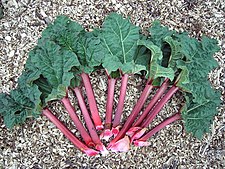 So let’s talk rhubarb. For those of you rhubarb virgins, here’s a little crash course. The rhubarb plant consists of long red stalks, leading to large triangular leaves. We consume the bright red stalks (the leaves are poisonous), however the stalks are only enjoyable after cooking (and adding some sugar to combat their tart nature). This is also why rhubarb is most classically paired with sweet strawberries. The two flavors work well together to balance out the tart of the rhubarb and perk up the sweet strawberry. You will most likely find rhubarb in grocery stores or farm stands trimmed of their leaves. If you’ve never seen fresh rhubarb, think bright pink celery.
 As most of you know, Scott and I enjoy our monthly wine tastings through our local wine store, Manchester Wine & Liquors. March’s subject, South African Wines, proved to be the best yet. I admit that I had high hopes for this particular tasting. I was interested to learn more about the wines from this region and was really hoping to pick up a couple of good bargains. The little I knew about South African wines was simply that they are decent wines, relatively new to the market, but still have “undiscovered” prices (a.k.a. dirt cheap.) I am happy to announce that the tasting did not disappoint – I learned quite a lot about the area and even more importantly, found some wonderful buys (both white and red) in the $10.00 range!

 at Amazon.com


 Chicken Pomodoro Paninis